Non-stick cookware
Non-stick pans, kadhais, tawas and sets. Compared on coating, base thickness, induction compatibility and handle build.
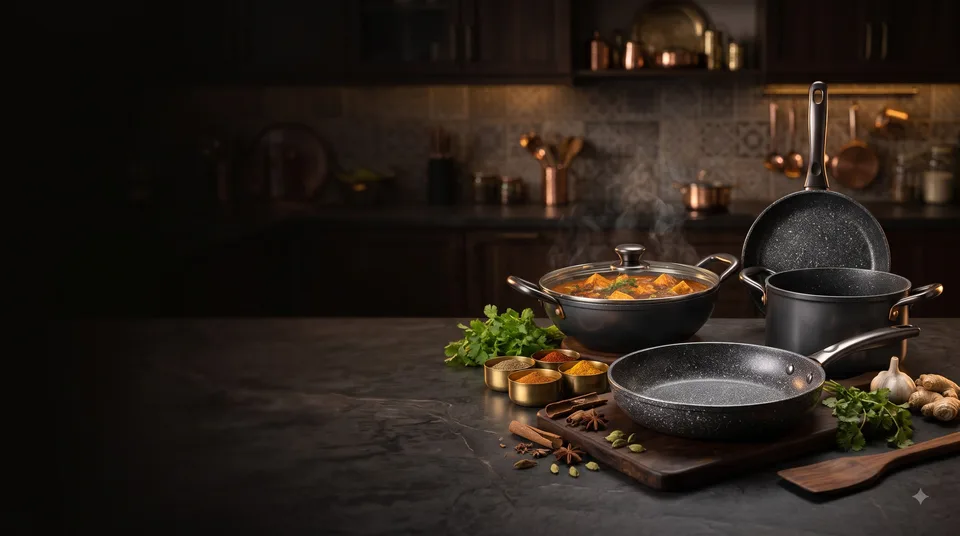
How to choose a non-stick pan
Before buying non-stick cookware, decide whether you will cook on gas, induction or both. Borosil says only stainless steel with a magnetic base works on induction. Hawkins describes its tri-ply range as a stainless steel cooking surface over an aluminium core, with a magnetic stainless steel base.
Coating care then decides how long a pan lasts. Hawkins advises low to medium heat for non-stick pans, because high temperatures shorten the coating's life.
Start with the best non-stick pan and the best non-stick cookware brand. Set buyers can read the best non-stick cookware set. Single-pan guides cover the best non-stick frying pan, the best non-stick saucepan and the best non-stick kadai. Indian staples have their own pages for the best non-stick tawa and the best non-stick dosa tawa.
The base and body come first. Borosil notes that stainless steel conducts heat poorly. Induction-friendly steel cookware therefore often adds aluminium in a multi-layered base. In Hawkins tri-ply, the cooking surface is 18/8 (AISI 304) stainless steel and the base is magnetic AISI 430. The maker says it works on gas, induction, electric, ceramic and halogen cooktops.
Hard anodised aluminium is another route. Hawkins says hard anodising forms a 60-micron layer of aluminium oxide as part of the metal. It describes the surface as non-toxic, non-staining and non-reactive with foods.
Cast iron suits some cooks. Hawkins says it generally works on induction but may not work well on some cooktops, so read the cooktop's instructions first.
Safety rules cover coatings. BIS says wrought aluminium utensils under IS 1660 need the ISI mark under a licence. The standard limits toxic metals in PTFE, ceramic, powder and high-temperature liquid coatings to 0.05 per cent each. The named metals are lead, cadmium and mercury. Chromium VI is named too.
All non-stick cookware guides
Non-stick cookware questions
Which utensils are safe on a non-stick surface?
Hawkins advises wooden, heat-resistant nylon, plastic or rubber tools. Metal utensils scratch the coating and shorten its life.
How do I wash these pans?
Wash non-stick and hard anodised pans by hand. Let them cool before putting them in water. Never use steel wool or abrasive scourers on the coating.
Should I leave an empty pan on the flame?
No. Hawkins advises limiting the preheating of an empty pan and never keeping a hot empty pan on the heat.
How do I look after cast iron?
Season it with oil, wash and dry it promptly, and oil it lightly before storing. This prevents rust. Keep it out of the dishwasher.